Introduction
Everyday carry equipment, often abbreviated as EDC, includes the small items people keep close at hand to handle ordinary tasks, unexpected inconveniences, and practical needs throughout the day. A typical EDC collection might include a wallet, keys, a flashlight, a writing instrument, and a compact multitool. For people who prefer carrying fewer separate objects, multifunctional accessories offer a way to combine several everyday functions into one portable item.
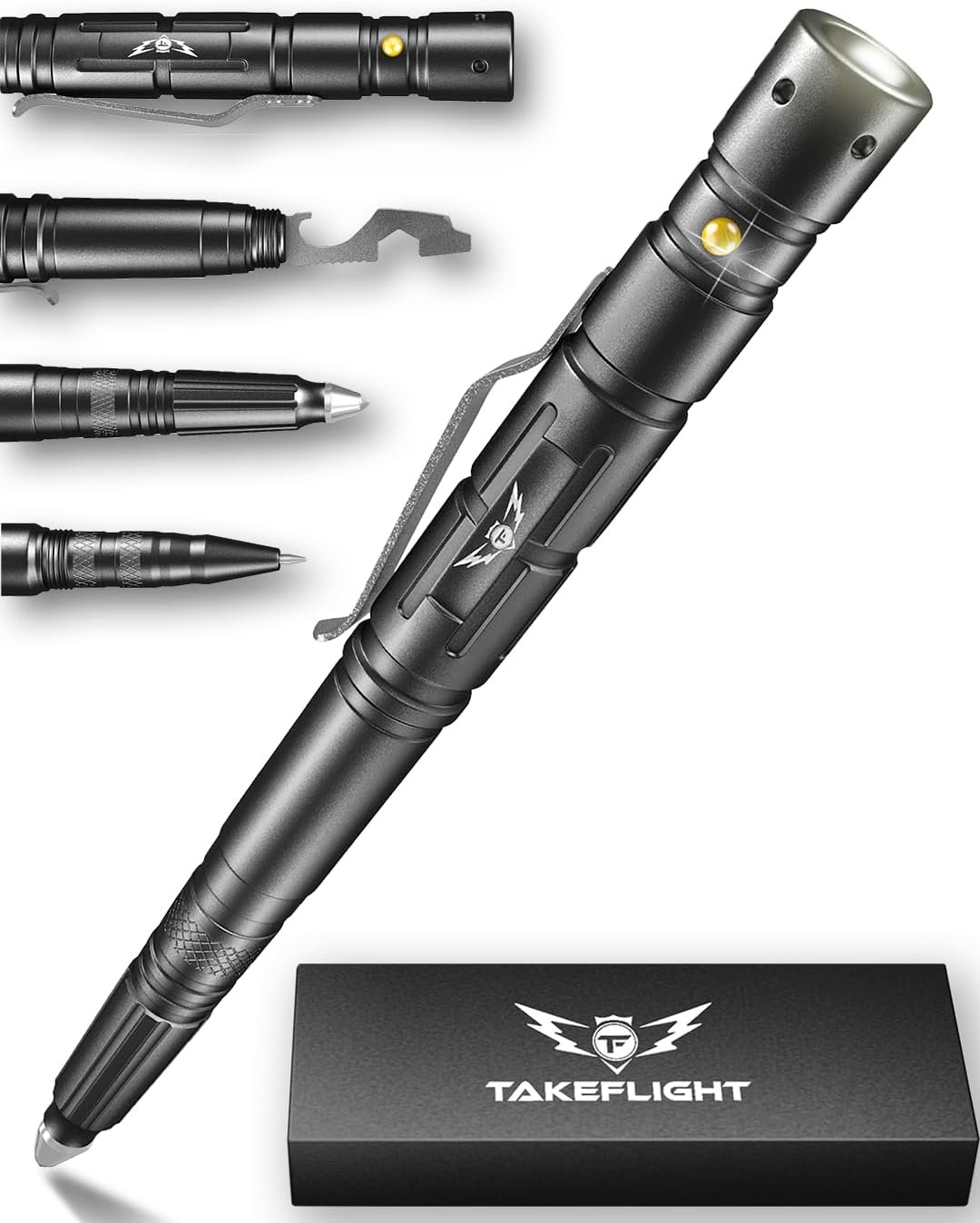
The TakeFlight Tactical Pen with LED Flashlight, Glass Breaker, and Bottle Opener is designed around this concept. According to its product title, it combines a writing instrument with several additional features associated with everyday utility and emergency preparedness. The package is also described as including two ink refills and an extra battery, which may be useful for maintaining the pen’s basic functions over time.
Although tactical pens are often associated with outdoor equipment, emergency kits, and personal preparedness, their practical applications can extend into ordinary routines. A pen is useful for taking notes, completing forms, and recording information. An integrated light may help illuminate a dark area, while a bottle opener can provide a convenient option for opening compatible bottles. A glass-breaking tip is intended for specialized emergency situations, although its safe and appropriate use depends on the circumstances, the design of the tool, and the surrounding environment.
Understanding how these features work together is important before choosing a multifunctional pen. Not every feature will be equally useful to every person, and a compact design necessarily involves compromises compared with dedicated equipment. A small integrated flashlight, for example, may serve different needs from a larger torch, while a pen with several attachments may not provide the same writing experience as a conventional office pen.
This guide explains the advertised functions of the TakeFlight tactical pen, explores possible everyday applications, and discusses practical considerations such as maintenance, portability, safety, and responsible use. The goal is to help readers determine whether this type of EDC accessory fits their routines without relying on unsupported performance claims or assumptions about the product.
Understanding the Tactical Pen Concept
A tactical pen is a writing instrument designed with a more robust or multifunctional construction than a conventional pen. Depending on the model, it may include a reinforced body, textured grip, emergency tool, flashlight, or other compact accessories.
The word tactical is used broadly in the marketplace. It does not automatically establish that a product meets a particular military standard, has been certified for emergency rescue, or is suitable for every demanding environment. The actual materials, construction, dimensions, and functions must be evaluated individually.
The TakeFlight model is presented as a multifunctional pen for everyday carry, with a focus on combining several accessories into a single item. Its advertised functions include writing, illumination, glass breaking, and bottle opening. This combination may appeal to someone who wants a compact accessory rather than several separate tools.
However, a multifunctional design should be viewed as a convenience rather than a replacement for all specialized equipment. A dedicated flashlight may offer more illumination, a purpose-built glass-breaking tool may be easier to deploy in a particular emergency, and a conventional pen may be more comfortable for extended writing. The value of a combination tool depends on which functions a person genuinely expects to use.
Key Features of the TakeFlight Tactical Pen
The product title identifies several functions and included accessories. The following sections explain their intended roles and the practical details worth checking. Exact specifications, such as dimensions, battery type, lighting output, materials, and operating instructions, should be confirmed through the current Amazon listing or the manufacturer’s documentation.
1. Integrated Writing Instrument
The primary function of any pen is writing. Even when a pen includes additional tools, its usefulness during an ordinary day depends partly on whether it can reliably record information.
A compact writing instrument may be useful for:
- Writing reminders and short notes.
- Completing paper forms.
- Recording contact details when a phone is unavailable.
- Making quick lists while shopping or travelling.
- Taking notes during meetings or training sessions.
- Keeping a backup writing instrument in a bag or emergency kit.
Having a pen available can be particularly convenient when a touchscreen is impractical, a device battery is depleted, or a paper document must be completed.
The product title states that two ink refills are included. Replacement refills can extend the pen’s usable life, provided that they are compatible with the pen’s internal mechanism. Before replacing a refill, check the manufacturer’s instructions for the correct type, length, and installation procedure. Refills that look similar are not necessarily interchangeable.
Writing comfort is another consideration. A tactical pen may have a different weight, grip shape, or balance from an ordinary ballpoint pen. These characteristics can affect how it feels during prolonged writing. People who regularly write several pages by hand may prefer to consider grip diameter, body shape, and overall weight before choosing this style of pen.
It is also worth distinguishing occasional writing from professional or academic use. Someone who needs a dependable pen for daily paperwork may prioritize ink availability and writing comfort, while someone who mainly wants an emergency accessory may place greater importance on the additional functions.
2. Built-In LED Flashlight
The integrated LED flashlight is one of the product’s advertised features. Combining a light with a pen can reduce the number of separate objects a person needs to carry, which is useful for people who prefer a compact EDC setup.
A small light may assist with tasks such as:
- Finding a keyhole in a dim entrance.
- Locating an item inside a bag.
- Reading a label in a poorly lit storage area.
- Looking beneath a desk or piece of furniture.
- Checking a car’s interior after dark.
- Illuminating a short walking route when a suitable alternative is unavailable.
An LED light can be particularly convenient because it places illumination within reach of the same item used for writing. Nevertheless, the practical value of an integrated flashlight depends on its brightness, beam pattern, battery capacity, switch design, and operating time.
The product title mentions an extra battery, but it does not establish the battery type, whether the battery is rechargeable, or the exact runtime of the flashlight. Those details should be checked before use. Keeping a spare battery is helpful only when it is compatible, stored appropriately, and installed according to the manufacturer’s instructions.
A pen-sized flashlight should not automatically be treated as a substitute for a dedicated torch. When walking along unlit roads, navigating uneven trails, performing detailed repairs, or working in an area where visibility is essential, a purpose-built flashlight may be a more suitable primary light source.
The integrated light is better understood as a supplementary convenience for brief, nearby tasks. If dependable illumination is important to your routine, compare the light’s documented specifications with the conditions in which you expect to use it.
3. Glass Breaker Feature
The advertised glass breaker is intended for specialized emergency applications involving compatible glass. Glass-breaking tools are sometimes included in vehicle emergency equipment because a damaged or inaccessible vehicle can create situations in which an alternative exit may be necessary.
However, a glass breaker is not a universal solution for every window or glass panel. Modern vehicles may use different types of glazing, and laminated glass can behave differently from tempered glass. A tool designed for certain types of glass may not work as expected on other materials.
Anyone considering this feature should understand several important limitations.
First, breaking glass creates immediate hazards. Fragments can cause serious cuts, and damaged glass may fall or move unexpectedly. Second, the surrounding environment matters: people nearby, traffic, unstable structures, and the position of the person using the tool can all affect the risk. Third, the exact capabilities of the pen’s glass-breaking component should not be assumed without reliable product documentation.
For these reasons, a glass-breaking feature should be regarded as a specialized emergency aid, not an invitation to experiment on ordinary windows or glass objects. Do not test it on vehicle windows, household glass, or other surfaces simply to see whether it works.
If you need a tool specifically for vehicle escape preparedness, compare the pen with dedicated emergency escape devices and consult their instructions. Check that the selected device is designed for the relevant type of glazing and can be reached quickly when needed.
A multifunctional pen may provide an additional option, but it should not replace a broader emergency plan or specialized equipment when those are necessary.
4. Bottle Opener
The bottle opener adds a familiar household function to the pen’s advertised feature set. A compatible opener may be useful during picnics, camping trips, outdoor meals, or other situations where a conventional bottle opener is not immediately available.
Combining this function with a writing instrument can be convenient for someone who already carries small accessories. Instead of adding another separate item to a keychain or bag, the user can keep several functions together.
As with other integrated tools, the actual usefulness depends on the opener’s shape, strength, accessibility, and compatibility with the bottle caps it is designed to handle. The product title does not establish that it works with every cap or container.
Use the opener only as intended. Avoid twisting or forcing the pen against a cap if it does not engage properly, because excessive force can damage the accessory or cause the hand to slip. Keep fingers clear of edges and moving parts, and inspect the tool if it becomes loose or visibly damaged.
The bottle opener is a secondary convenience, not the main reason most people need a writing instrument. Its value will depend on how often the user encounters situations in which this function is useful.
5. Compact Multifunctional Design
The central idea behind a tactical pen is combining several functions in one object. The TakeFlight model’s advertised writing, lighting, glass-breaking, and bottle-opening capabilities are intended to reduce the need to carry each accessory separately.
A compact combination tool can make sense for people who travel regularly, carry a small bag, or want a few basic accessories available throughout the day. It may also suit someone who prefers a consistent place to keep essential items rather than storing them across different pockets and compartments.
However, combining functions introduces trade-offs. A multifunctional pen may be heavier or thicker than a standard pen. The additional components can also create more maintenance requirements, especially when the design includes a battery-powered light.
The location of the controls and attachments matters, too. A tool may technically offer several features, but those features are less useful if they are difficult to access or interfere with normal writing. Prospective buyers should consider whether the design is convenient to carry and whether its layout suits their everyday habits.
The most useful EDC setup is not necessarily the one with the greatest number of features. It is the one that provides practical functions without adding unnecessary weight, complexity, or inconvenience.
6. Two Ink Refills and an Extra Battery
The included replacement accessories are worth considering separately from the pen itself. Consumable components determine how easily an accessory can remain useful after its initial supplies are exhausted.
The product title identifies two ink refills and an extra battery. These additions may reduce the need to source replacements immediately, but their value depends on compatibility and storage.
For the ink refills, confirm the replacement format and follow the manufacturer’s instructions. Store unused refills in a clean, dry place and avoid exposing them to conditions that could cause ink leakage or damage.
For the battery, verify the exact battery type, polarity, and installation method. Do not substitute an unapproved battery simply because its dimensions appear similar. Keep spare batteries away from loose metal objects, moisture, and excessive heat. Follow the battery manufacturer’s guidance for storage, transport, and disposal.
If the pen will be stored for a long period, inspect its condition periodically. Check for ink leakage, corrosion, damaged seals, loose components, or battery leakage. Remove the battery during extended storage if the manufacturer’s instructions recommend doing so.
Replacement accessories are most useful when the user knows how to maintain the item safely and can obtain compatible supplies when needed.
How the Tactical Pen Can Be Used
The different functions make the TakeFlight tactical pen potentially useful across several settings. The following examples illustrate ordinary applications without assuming that every feature will be necessary in every situation.
Everyday Work and Study
A pen remains useful in environments where written notes are part of the routine. Students may use one to record reminders, complete worksheets, or take notes during discussions. Office workers may use it for meeting notes, paper forms, and quick annotations.
The flashlight can provide supplementary illumination when searching through a desk drawer or checking a poorly lit storage space. The bottle opener may occasionally be useful during a break or informal gathering.
For work or study, consider whether the pen writes comfortably and whether its additional components are permitted in the environment. Some workplaces, examination venues, government facilities, and secure buildings restrict tools with pointed or reinforced components. Check local policies before carrying it into such locations.
Vehicle Emergency Preparation
Drivers sometimes keep compact accessories in a glove compartment, emergency pouch, or centre console. A pen can be used for recording information after a minor incident, writing down contact details, or completing paperwork.
An integrated light may also help illuminate nearby objects when the vehicle is parked in a safe location. It can be useful when locating an item or reading a label in low light.
The glass breaker may be relevant to emergency preparedness, but it should not be relied upon without understanding its limitations. A vehicle escape tool should be selected based on the type of glazing it can address, the instructions supplied by its manufacturer, and whether it can be accessed under stressful conditions.
A well-prepared vehicle kit may also include a dedicated flashlight, reflective warning equipment, a first-aid kit, water, a phone charging solution, and other items appropriate to the climate and journey. A tactical pen can supplement such a kit, but it cannot replace these separate essentials.
Travel and Commuting
Commuters often benefit from carrying fewer small accessories. A multifunctional pen may fit into an organizer, backpack pocket, or work bag, where it can remain available for writing and brief illumination tasks.
Before travelling, check the rules of the destination and the transportation provider. Certain tools may be restricted in airports, aircraft cabins, courts, public buildings, and other controlled environments. Rules can vary by country and by the exact design of the item.
Do not assume that a product is permitted simply because it is marketed for everyday carry. If you are flying, consult the airline and relevant airport security guidance before packing it. When regulations are unclear, leaving the tool at home may be the simplest option.
Camping and Outdoor Activities
Outdoor activities can involve changing light conditions and limited access to household tools. A pen may help record a route note, write down a campsite detail, or label an item. The integrated LED may provide supplementary light for a short task near camp.
The bottle opener may be convenient during an outdoor meal, depending on the containers being used.
For camping, hiking, or extended outdoor trips, consider the environmental conditions. Moisture, dirt, temperature changes, and repeated handling can affect small mechanical and electrical components. A pen designed for everyday carry should not automatically be assumed to be waterproof, corrosion-proof, or suitable for harsh environments.
Outdoor users should also carry appropriate primary equipment. A reliable headlamp or flashlight, navigation tools, suitable clothing, first-aid supplies, and enough water are more important than the number of functions built into a single pen.
Home and Workshop Tasks
At home, a compact pen can serve as a convenient writing tool for notes, labels, and checklists. The flashlight may help locate an object in a dim cupboard or illuminate a nearby area while checking a piece of furniture.
The bottle opener is an occasional household convenience, while the glass-breaking feature is intended for specialized circumstances rather than routine home maintenance.
A multifunctional pen is not a substitute for proper workshop tools. If a task requires significant force, precision, electrical insulation, or a tool designed for a particular material, use the appropriate equipment instead.
Who May Find This Type of Pen Useful?
A multifunctional EDC pen is not essential for everyone. Its suitability depends on the user’s daily routine, preferred carry method, and expectations of the additional features.
People Who Prefer Compact Everyday Carry
Someone who wants to combine a few accessories in one item may appreciate the convenience of a pen that includes a light and other tools. It may be especially appealing to people who already keep a small organizer or bag for everyday essentials.
The main consideration is whether the combined design actually reduces clutter. If the pen is too bulky or the additional functions are rarely used, a conventional pen and a separate small flashlight may be more practical.
Drivers Who Maintain an Emergency Kit
Drivers who organize their vehicles for unexpected situations may consider a multifunctional pen as a supplementary accessory. Its writing function can be useful for recording information, while the light may assist with nearby tasks.
However, anyone choosing a tool for vehicle escape should evaluate the glass-breaking component carefully and should not depend on an unverified feature as the sole means of emergency egress.
Campers and Casual Outdoor Users
People who participate in picnics, car camping, or other casual outdoor activities may appreciate having a pen and small light together. The bottle opener could also be useful in settings where compatible bottled drinks are served.
For remote or demanding outdoor activities, the pen should be considered a secondary convenience. Specialized lighting, navigation, shelter, and emergency supplies remain important.
People Shopping for Practical Gifts
A multifunctional pen may appeal to someone who enjoys compact tools, outdoor accessories, or practical desk equipment. The combination of familiar and specialized functions can make it an interesting gift for a colleague, family member, or friend.
Gift-givers should consider the recipient’s habits rather than focusing only on the number of advertised features. Someone who writes extensively may value comfort and refill availability, while someone who travels frequently may care more about weight and transport restrictions.
Because this model is marketed as veteran-owned, that positioning may also be relevant to shoppers who intentionally look for businesses with that background. Any specific ownership, service, or business claims should be confirmed through the seller’s current information if they are important to a purchasing decision.
Important Things to Consider Before Choosing a Tactical Pen
Multifunctional tools can be useful, but their practical value depends on several details that may not be obvious from a product title.
Confirm the Materials and Construction
The product title does not provide enough information to establish every material used in the pen. Check the listing and manufacturer documentation for the body material, grip design, construction details, and any care instructions.
A reinforced appearance does not necessarily establish a specific level of durability. Likewise, a product described as tactical should not be assumed to meet military, industrial, or professional rescue standards unless appropriate documentation supports that claim.
Check Dimensions and Weight
Portability is one of the main reasons to choose an EDC accessory. Before selecting a multifunctional pen, check its length, diameter, and weight if those measurements are available.
A larger body may be easier for some people to grip, but it may not fit comfortably in a shirt pocket or slim organizer. A heavier design may feel substantial to one person and inconvenient to another.
If you plan to carry the pen daily, consider where it will be stored and whether it could snag on clothing, damage other objects, or become uncomfortable when seated.
Understand the Flashlight Specifications
A useful flashlight should match the environment in which it will be used. Look for documented information about brightness, beam characteristics, battery type, operating time, and switch operation.
If the listing does not provide those details, avoid assuming that the light is suitable for long-duration use, outdoor navigation, or emergency signalling at a distance.
Also consider whether the light can be operated easily without interfering with the writing function. For people who frequently work in darkness, a dedicated headlamp or flashlight may provide a more suitable combination of output, battery capacity, and hands-free operation.
Verify Refill and Battery Compatibility
Included replacement supplies are useful only when they fit the product and remain in good condition. Confirm the refill format before purchasing additional ink and check the manufacturer’s battery requirements.
Do not attempt to modify the pen’s electrical components or force incompatible accessories into place. If a battery leaks, becomes unusually hot, or shows signs of damage, stop using it and follow appropriate battery safety guidance.
Consider the Intended Glass Type
A glass breaker may have a limited range of compatible applications. The term should not be interpreted as a guarantee that it can break every type of glass.
Vehicle windows can use tempered or laminated glass, and their behaviour under impact differs. A tool’s suitability depends on its design and the glazing involved. If vehicle escape is a priority, consult the relevant vehicle documentation and the tool manufacturer’s instructions, and consider a dedicated emergency device designed for the intended application.
Avoid testing the glass breaker casually. Unnecessary glass breakage can result in injury, property damage, and legal complications.
Review Local Laws and Carrying Restrictions
Rules governing pointed tools, reinforced pens, and other tactical-style accessories vary across jurisdictions. Some locations regulate specific designs or how an item may be carried, while individual institutions may have stricter policies.
Check the applicable laws and venue rules before carrying the pen in public buildings, schools, courts, airports, or other controlled environments. A product’s commercial availability does not mean it can be carried everywhere.
The same principle applies when travelling internationally. A tool that is lawful to own at home may be restricted elsewhere.
Avoid Treating It as a Guaranteed Self-Defense Solution
The product title uses the phrase “self defense,” but marketing terminology does not establish how effective an object would be in a dangerous encounter. A multifunctional pen should not be regarded as a guarantee of personal safety.
Situations involving threats or physical confrontation are unpredictable. Carrying a tool can introduce additional risks, and laws concerning its use may differ depending on the circumstances and location.
For personal safety, prevention, awareness, leaving an unsafe environment, contacting emergency services, and following local guidance are generally more important than relying on a compact accessory. Anyone considering a self-defense tool should understand the relevant laws and receive appropriate professional instruction where necessary.
Comparing General Categories of Everyday Carry Pens and Tools
There are several ways to organize an everyday carry setup. The right approach depends on whether portability, writing comfort, illumination, or specialized emergency functions matters most.
Conventional Ballpoint Pens
A conventional ballpoint pen is designed primarily for writing. Its advantages may include a familiar shape, lightweight construction, and widely available replacement refills.
For students, office workers, and people who write regularly, a simple pen may be more comfortable and less complicated than a multifunctional alternative. It usually does not provide integrated lighting or other tools, so additional accessories may be needed for those tasks.
Multifunctional Tactical Pens
A multifunctional tactical pen combines writing with one or more additional functions. The TakeFlight model is advertised with an LED flashlight, glass breaker, and bottle opener.
The main potential advantage is consolidation: several functions are available in one portable object. The trade-off is that the body may be bulkier, the mechanism may require more maintenance, and some functions may be less capable than dedicated equipment.
This category may suit users who value compactness and occasional utility more than specialized performance in any single function.
Dedicated EDC Flashlights
A dedicated flashlight is designed primarily for illumination. Depending on the model, it may offer a broader range of brightness settings, more detailed battery information, and features tailored to regular lighting needs.
A separate flashlight also allows the user to choose a design based on grip, beam shape, runtime, and weather resistance. The disadvantage is that it adds another object to carry and maintain.
If lighting is essential to a person’s work or outdoor activities, a dedicated light may be more suitable than relying on the small flashlight integrated into a pen.
Dedicated Emergency Escape Tools
Emergency escape tools are designed around a narrower purpose, such as assisting with escape from certain vehicle emergencies. Their capabilities depend on their design and the types of glass they are intended to address.
A tactical pen that includes a glass-breaking feature may offer an additional option, but it should not automatically be treated as equivalent to a dedicated escape tool. Anyone choosing equipment for this specific purpose should examine manufacturer documentation and verify suitability for the intended situation.
General Multitools
A general multitool may combine functions such as pliers, screwdrivers, blades, and other implements. These tools are often intended for small repairs and practical tasks rather than writing.
They can provide more mechanical functionality than a tactical pen but may be heavier and subject to additional carrying restrictions. The appropriate choice depends on which functions the user expects to need.
Ultimately, the most effective everyday carry arrangement is the one that matches real needs. A simple pen may be enough for an office worker, while someone who spends time outdoors may prefer a pen, a dedicated light, and separate emergency equipment.
Frequently Asked Questions
What is a tactical pen?
A tactical pen is a writing instrument that may incorporate a reinforced body or additional utility features. Depending on the model, those features can include a flashlight, glass breaker, bottle opener, or other compact tools. The exact functions vary by product.
What features are advertised for the TakeFlight tactical pen?
The product title identifies a writing instrument, an LED flashlight, a glass breaker, and a bottle opener. It also states that two ink refills and an extra battery are included. Buyers should consult the current listing for confirmed specifications and instructions.
Does the pen include replacement ink?
According to the product title, the package includes two ink refills. Check the current listing to confirm the included items and verify the refill format before ordering additional supplies.
Is an extra battery included?
The product title specifies an extra battery. The exact battery type and whether it is rechargeable should be confirmed through the current product information. Always use compatible batteries and follow the manufacturer’s instructions.
Can the integrated flashlight replace a regular flashlight?
That depends on the flashlight’s documented output, beam pattern, runtime, and intended use. An integrated light may be useful for brief, nearby tasks, but a dedicated flashlight is generally worth considering when dependable illumination is important for outdoor activities, work, or emergencies.
Can the glass breaker work on every window?
No universal assumption should be made. Different windows use different types of glass, and laminated glass may respond differently from tempered glass. Check the tool manufacturer’s guidance and the relevant glazing specifications. Never test the feature on ordinary windows or vehicle glass without a legitimate, controlled reason.
Is the pen suitable for vehicle emergency preparation?
It may be considered as a supplementary accessory, particularly for writing and brief illumination. However, the glass-breaking feature should not be relied upon as a guaranteed escape method. For vehicle emergencies, consider dedicated equipment whose compatibility and instructions are clearly documented.
Is it appropriate for everyday office use?
It can be used as a writing instrument if its size, weight, and writing comfort suit the user. Nevertheless, some workplaces or secure facilities restrict tactical-style accessories. Check the applicable policies before carrying it into restricted environments.
Can it be carried on an airplane?
Do not assume that it is permitted in carry-on baggage. Transportation rules can vary by country, airport, airline, and the design of the item. Check official security requirements before travelling and follow instructions from the relevant authorities.
Is it waterproof?
The product title does not establish a waterproof rating. Unless the manufacturer provides a verified rating and usage instructions, avoid exposing the pen to heavy rain, immersion, or other conditions that could damage its electrical components.
Who might appreciate this pen as a gift?
It may appeal to people interested in everyday carry accessories, practical gadgets, camping equipment, or compact multitools. Before choosing it as a gift, consider whether the recipient would actually use the added functions and whether the design is suitable for their workplace and local carrying rules.
How should the pen be maintained?
Keep it clean and dry, inspect it for visible damage, replace the ink refill when needed, and follow the manufacturer’s instructions for battery replacement. Store spare accessories appropriately, and discontinue use if the body, light, battery compartment, or other components become damaged.
Does a tactical pen guarantee personal protection?
No. The presence of a feature marketed for self-defense does not guarantee protection or a particular outcome. Personal safety depends on the situation, local laws, awareness, and the actions available to the individual. A compact tool should not replace sound safety planning.
Conclusion
The TakeFlight Tactical Pen with LED Flashlight, Glass Breaker, and Bottle Opener is presented as a multifunctional everyday carry accessory that combines writing with several additional utilities. The product title also identifies two ink refills and an extra battery, which may help users maintain the pen’s basic functions when compatible replacement supplies are needed.
Its main appeal is the possibility of keeping a writing instrument, a small light, and selected utility features together rather than carrying each item separately. This arrangement may be convenient for commuters, office workers, casual outdoor users, and people who prefer compact accessories.
At the same time, the pen should be evaluated according to what it can reasonably provide. The integrated flashlight may be suitable for brief tasks without replacing a dedicated light. The bottle opener offers a limited convenience, while the glass-breaking feature requires careful attention to compatibility, safety, and emergency circumstances. None of these functions should be assumed to deliver a particular level of performance without supporting documentation.
Before choosing this type of product, review the current listing for dimensions, materials, battery requirements, refill compatibility, lighting specifications, and instructions for the additional features. Consider your usual environment, local carrying restrictions, and whether a multifunctional design genuinely meets your needs better than separate tools.
If you are looking for a compact pen with several advertised utility functions,
you can check more details on Amazon here:
As an Amazon Associate, we earn from qualifying purchases.
Leave a Reply